RESEARCH QUESTION
How should a manufacturer compare Vietnam, Malaysia, Thailand and Indonesia before committing to a location?
Web summary of the published research report · Research cutoff: 20 September 2026 (UTC+8). The summary does not update the underlying research.
What the report examines
Begin with the product.
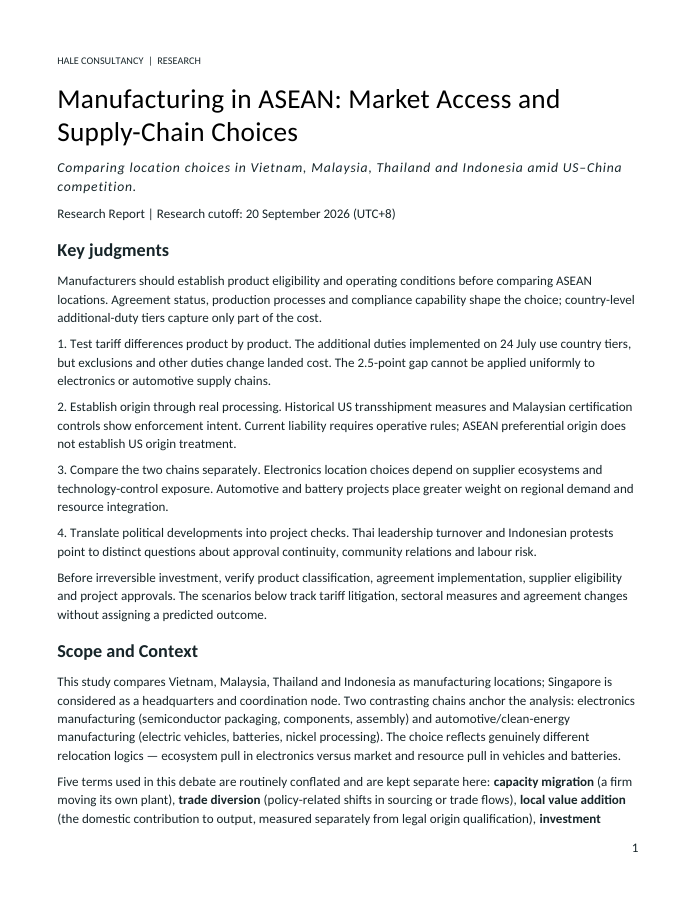
The report starts with product classification, destination-market treatment and the processing that takes place at each site. Country-level tariff comparisons alone cannot establish the cost or eligibility of a particular shipment.
Compare different production chains separately.
Electronics and automotive or battery projects face different constraints. The analysis considers supplier depth and technology exposure alongside regional demand, resources and operating conditions.
Translate political developments into project checks.
Policy announcements, leadership changes and negotiations become useful inputs when connected to permits, supplier eligibility, labour conditions and investment timing. The report distinguishes announced investment from disbursed capital and operating production.
Scope and method.
The study compares four manufacturing locations, with Singapore considered as a coordination node. It draws on official trade and customs materials, investment agencies, company disclosures and public reporting. The scenarios identify observable triggers and responses without assigning probabilities.
Published by Hale Consultancy. The PDF contains the full analysis and source list.
Limits of the assessment.
The comparisons do not establish eligibility for a specific product, supplier or site. Tariff treatment, agreement implementation and approvals require checks against the applicable instruments and project facts. The report is a dated assessment, not a continuously updated tariff schedule.
Selected references.
These references appear in the original report. Linked pages may change after the research cutoff; consult the PDF for the source context and the dated assessment.
- ASEAN Secretariat — ASEAN Trade in Goods Agreement
- European Commission — EU trade relations with Vietnam
- Amkor — Vietnam factory inauguration